

"Someone Needs to Get Her Help"
On concern as a form of consumption, what the research says actually moves a person toward eating disorder treatment, and the twenty years I spent being the one people commented on.

If this were 25 years ago, I’d be printing out the photos of Ariana Grande that are going around the internet right now and glue-sticking them into a journal.
I had one in high school for exactly that purpose. We had the word thinspiration and we had the internet version of it too, the pro-ana communities on LiveJournal and anywhere else that would host them for a while before getting shut down. But mine was also a physical object: Lindsay Lohan and Nicole Richie and every other is-she-or-isn’t-she ingenue of the early 2000s, words like DIET and THIN and admittedly semi-disturbing segments of bodies I coveted then, like prominent collarbones thigh gaps or bony ankles, all cut out of magazines I bought at the CVS, glue-sticked onto college-ruled paper.
Either way, it took effort. The magazine or the message board, I had to go get it. I had to want it enough to buy the thing, find the scissors, sit on the floor of my bedroom and assemble it by hand, or to go looking for the community and keep going back. This month my Instagram feed has been building me a new one, free of charge, without my ever asking for it (and certainly without wanting it), while I was doing something else.
I’m not going to tell you what’s wrong with Ariana Grande, because I don’t know, and neither does anybody else posting about it (which is closer to the subject of this essay than her body is). What I can tell you is that I wasn’t seeing this much of her until the conversation stopped being just about her body and became an argument about whether saying she needs help is helping. Now I can’t scroll without seeing her. The debate about the coverage became the coverage, and the debate has two sides that both think they’re the good one.
The comment
The majority of the posts I keep seeing are not cruel. That’s what makes them worth writing about. They’re mostly some version of she looks so unwell, this is scary, I hope someone around her is paying attention, someone needs to get her help. Sincere. Often from women, and often from women who have been through something themselves, or who are close to someone who has (mothers, sisters, best friends, etc), and recognize what they think they’re seeing.
I understand the impulse behind those posts completely (I’ve had the same one about strangers, and about people I love, and about myself in old photographs). The impulse isn’t the problem.
The problem is that the posts demonstrating concern for Ariana do nothing for her and something measurable to everyone else.
Because this is the internet, some of the comments are cruel. But mostly they’re an argument about whether the scrutiny should be allowed at all: one side saying it isn’t our business and it won’t help her anyway, the other saying that staying quiet is exactly how “this” gets normalized. Both sides are certain, and certainty is engaging. Which means the argument about whether we should be talking about her body is itself the thing keeping her body in front of everyone. Every like and reply is a signal to the algorithm that people are staying for this, and the feed responds to that signal the only way it knows how, by finding more people to show it to.
I spent a chunk of the past week trying to find out what these posts actually do, returning to research I’d used in an Eating Disorders Awareness Week deck I posted every February for years and going after the newer work I hadn’t read yet. I’ve also spent 17 years as a brand strategist, which means I make a living being rigorous about what evidence actually supports, and I wanted to know whether my own experience was idiosyncratic or documented. Some of it is documented. The rest is a gap, and the gap turned out to be its own finding.
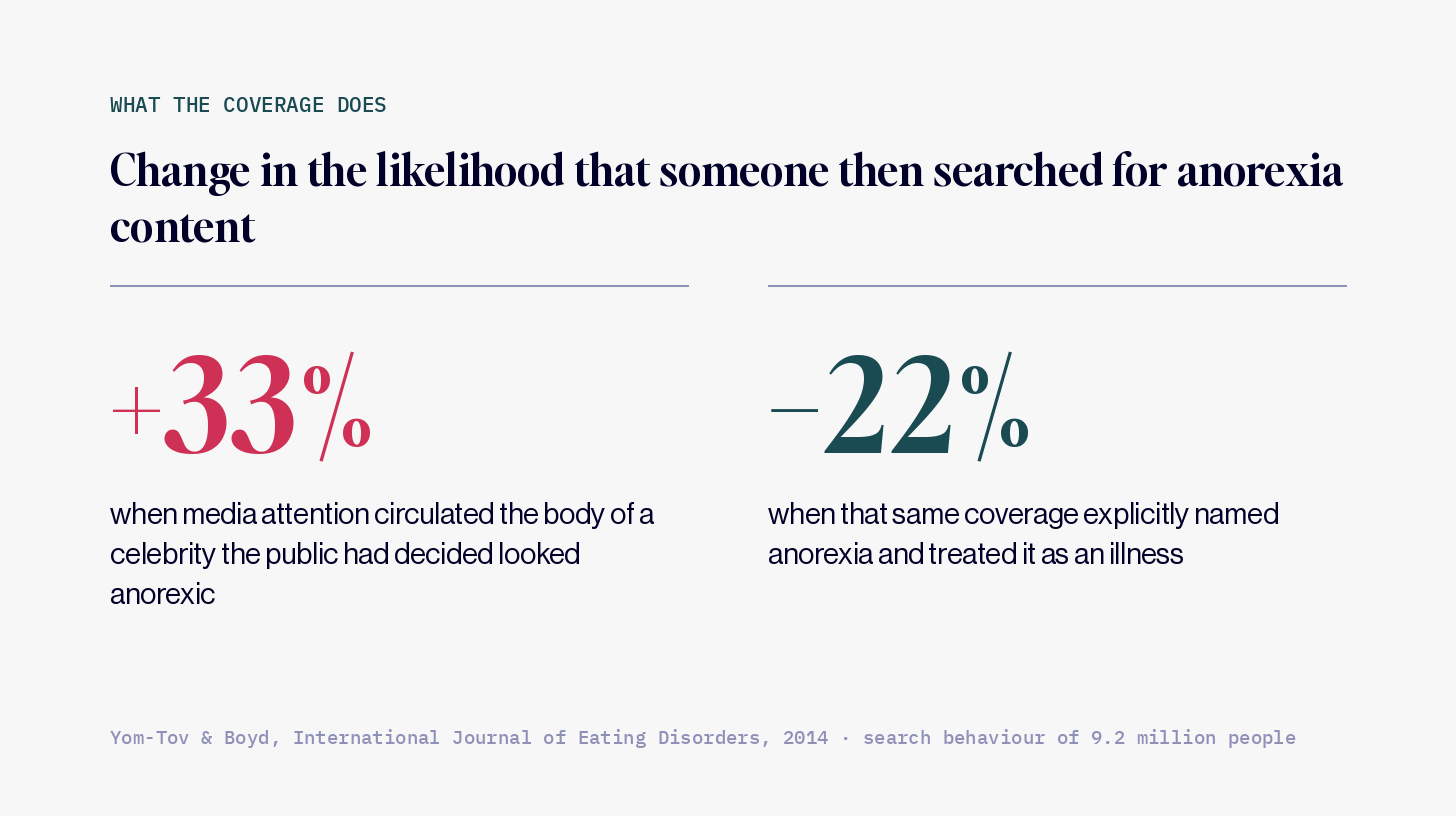
In a study of the search behavior of 9.2 million people, when media attention focused on a celebrity the public perceived as anorexic, the hazard of those users then running anorexia-related searches rose 33%.
When a celebrity’s eating disorder disclosure made headlines in 2012, US pro-eating-disorder search volume rose roughly 37% in a month, with no comparable spike for the lower-profile disclosures.
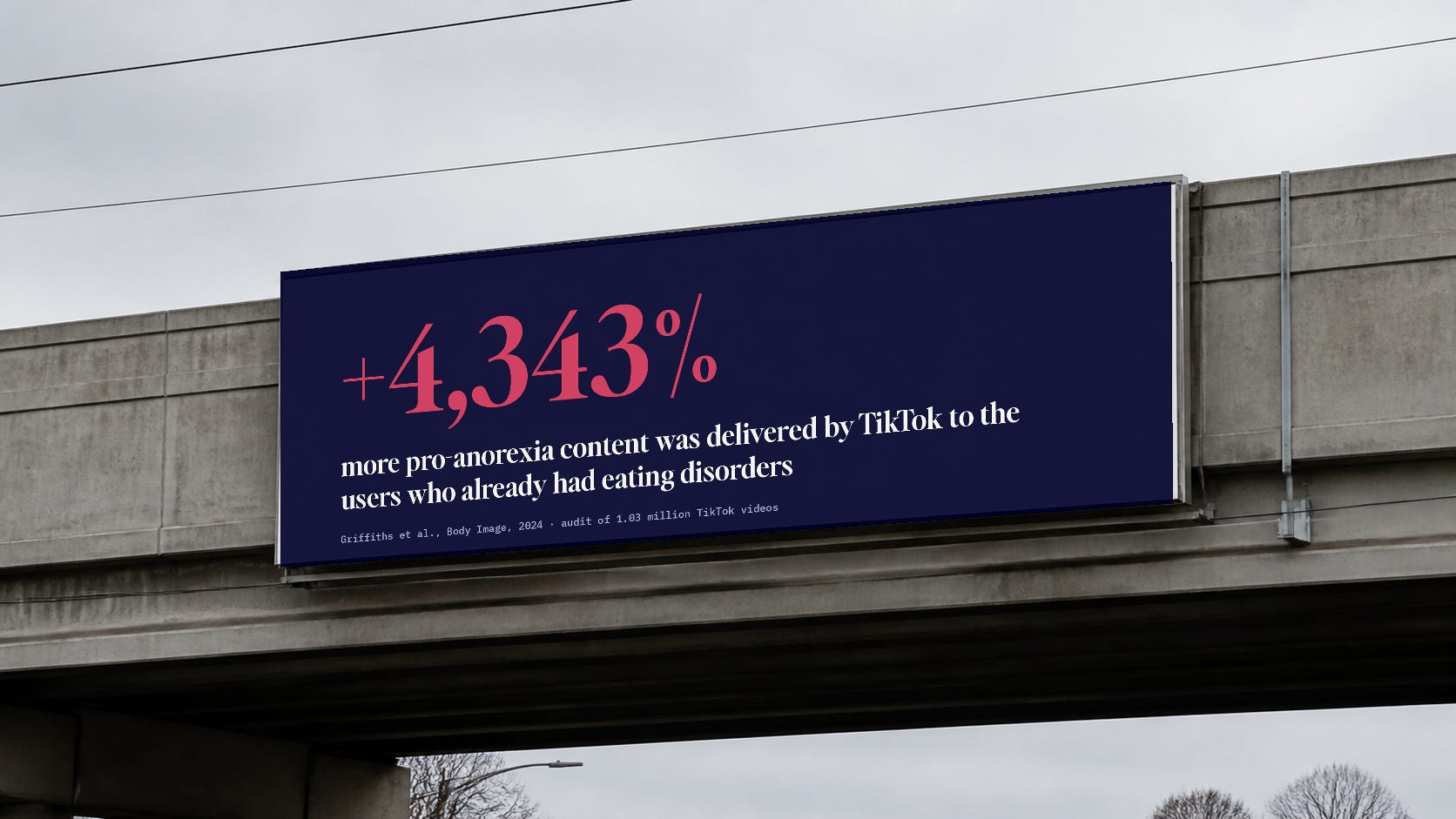
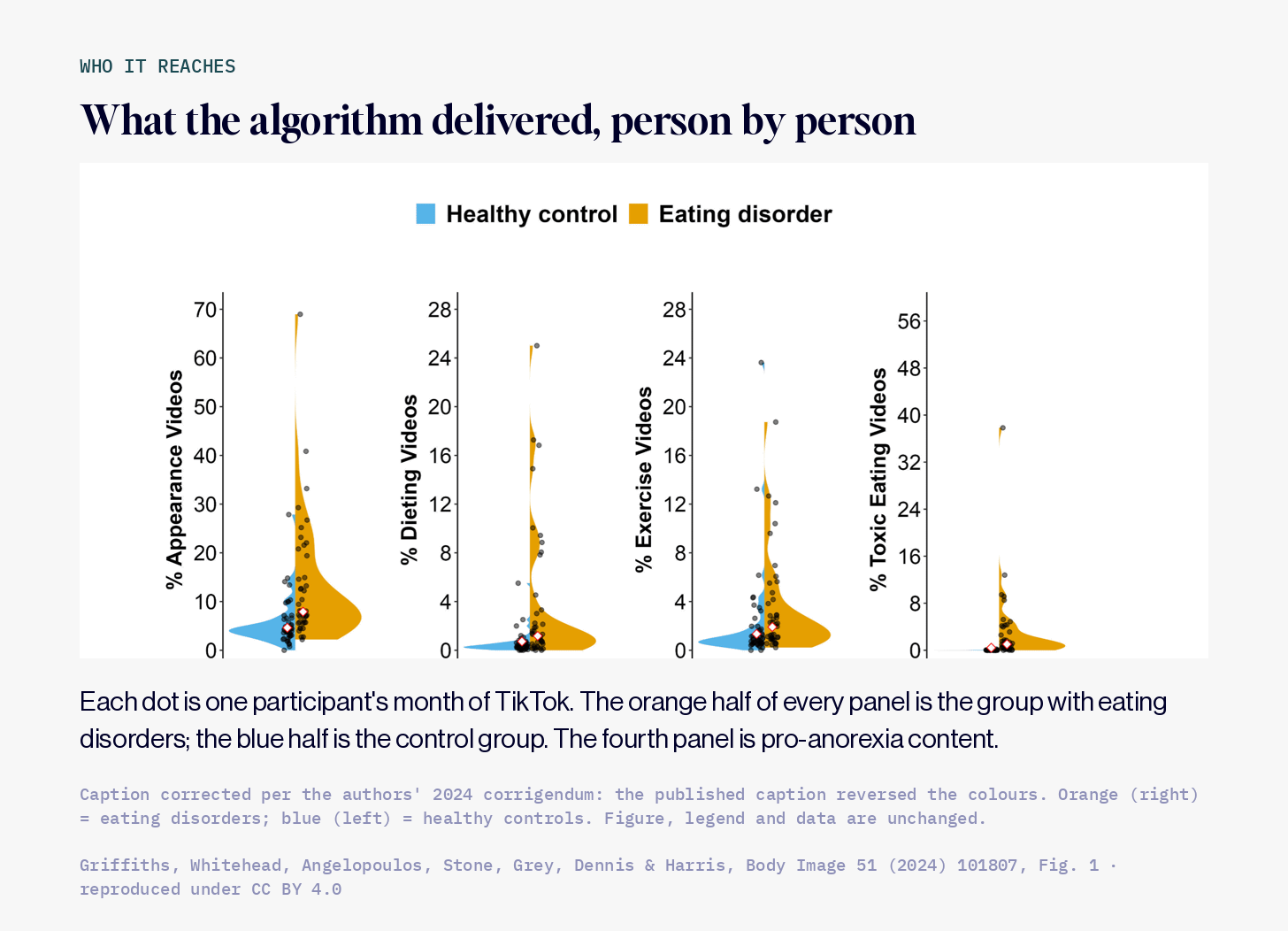
And in an audit of 1.03 million TikTok videos actually delivered to real people’s feeds over a single month, the users who had eating disorders received 4,343% more pro-anorexia-type content than the control group. (4,343% is not a typo. I double-checked.)
The obvious objection to that last one is that of course they did. People with eating disorders engage more with this material, the algorithm notices, the algorithm serves more of it, and what you’re looking at is a machine doing exactly what it was built to do with the inputs it was given. I had the same thought. The researchers had it first, and they checked: the gap was far larger than the users’ own engagement could account for, and it actually scaled with how sick they were. The sicker the user, the wider the gap, which is a good deal more than a feed reflecting somebody’s own clicking back at them.
That last one is the one I’d put on a billboard if billboards worked on the people who need them. The conversation does not land evenly across the public. It gets sorted, by machine, toward the people least able to hold it, which means that when a hundred thousand people post their concern about one woman’s body, the concern doesn’t travel to her at all. It travels to the seventeen-year-old whose feed had already quietly decided she was the audience for this.
The same sentence
What I can speak to without a citation is what it’s like to be the one being discussed, because I was that for more than 20 years.
At my sickest, the compliments were fuel. That much people are willing to hear. What’s harder to say out loud (well, write, I guess) is that the concern was fuel too. You look amazing and you’re getting too thin were the same sentence to me. Both meant it was working. Being noticed was how I could tell my efforts were paying off, validation from outside that something I had no reliable way of seeing myself was real (since body dysmorphia comes with the territory.) The alarm in the second one didn’t arrive as alarm. It arrived as evidence, and evidence was the entire currency I was operating in.
Eating disorders are an illness that take every single input and metabolize it into evidence, and I don’t think you can talk somebody out of that from a comment section any more than you could talk them out of it standing in their kitchen.
It isn’t only my account of it either. In interview studies with patients, people describe deliberately restricting harder after being told they didn’t look sick enough, appearance comments running dangerous in both directions at once, praise and doubt both landing as instruction. And there’s a study of adults with atypical anorexia (people whose bodies don’t look like the diagram, which is most people with eating disorders) where what they report is providers praising their discipline, their restriction, their progress. Not strangers on the internet. Their doctors.
If clinical approval can function as fuel, a comment section is not going to be the thing that reaches somebody.
The gap
I went looking for research on whether a stranger’s concern has ever moved anyone toward treatment, and there isn’t any that I could find: no US study measuring whether an unsolicited comment from a stranger about someone’s body moved that person toward eating disorder treatment or recovery. What does exist is the American research on weight stigma, and all of it points the other way.
Which leaves an odd asymmetry.
The intervention everybody reaches for (say something, publicly, so she knows people are worried) has no supporting data behind it at all. The thing that does have evidence behind it is the harm.
We have measured, repeatedly and at scale, what this kind of talking does to the people watching it. Nobody has managed to measure it doing anything for the person being talked about.
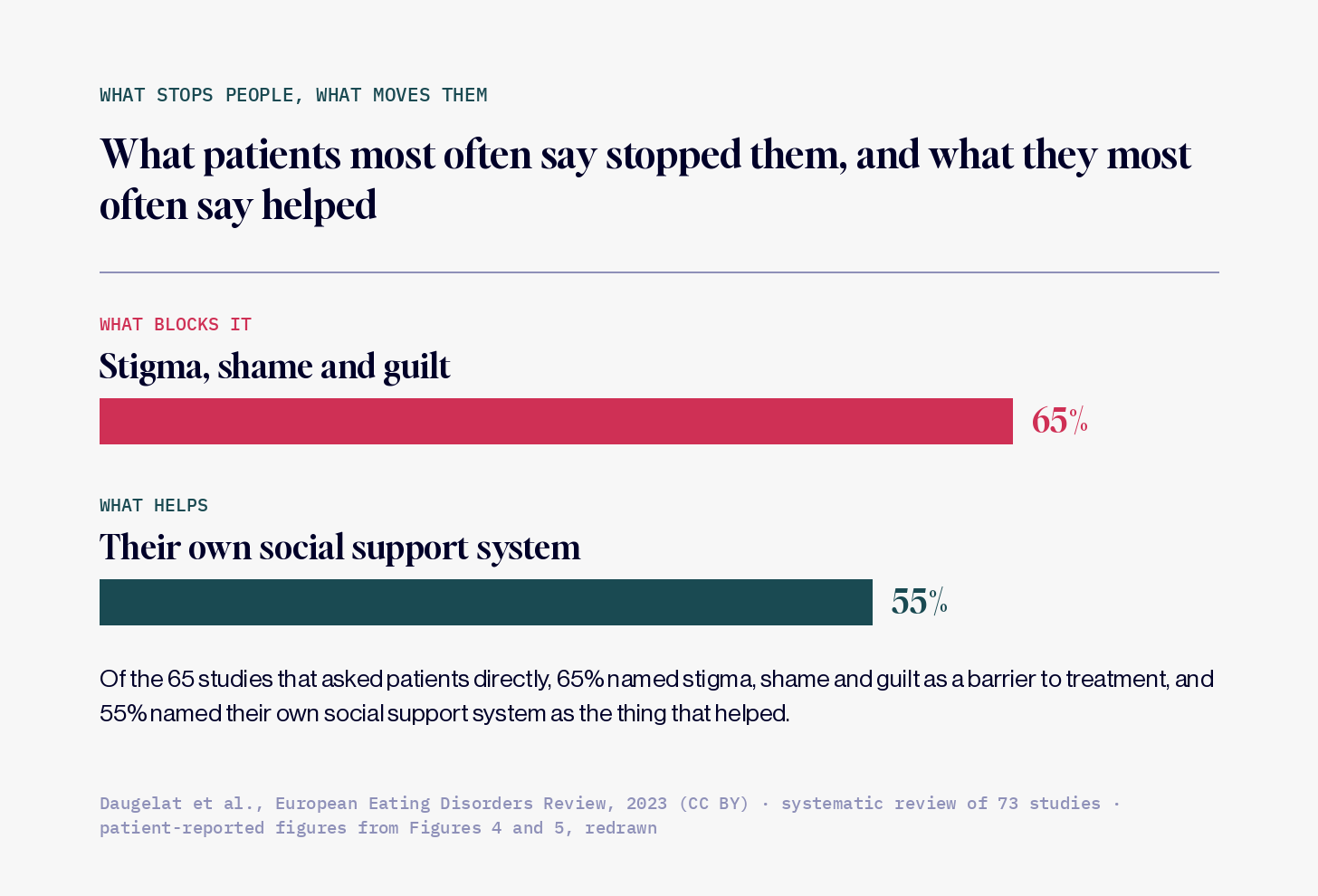
People get help faster when a person they actually trust raises it first — a mother, a partner, a friend — instead of having to bring it up alone. Positive social support is the best-documented facilitator of getting into treatment at all, across 73 studies, and shame is the most consistent barrier. Confrontation and ultimatums have never been tested in a single trial, and everything adjacent suggests they backfire. So the whole finding, the entire evidence-backed intervention, is one person who knows you, saying it plainly, once, and then not going anywhere.
I got there eventually, and “eventually” is carrying a great deal of weight in that sentence (pun not intended). It took more than 20 years, seven rounds of treatment, and a number of relapses I’ve stopped counting as failures. The delay is not unusual: the average stretch between developing an eating disorder and being treated for it runs about 2.5 years for anorexia, 4.4 for bulimia, 5.6 for binge-eating disorder, and only about 30% of people with eating disorders ever get help at all, a number that hasn’t moved in a decade.
What finally stuck for me was a different kind of treatment altogether. The program that got me to lasting recovery was built on Health at Every Size and intuitive eating, and what it did differently was refuse to assign morality to anything. Not to numbers on the scale, not to foods, not to food groups, not to exercise or particular kinds of exercise. Pizza was not bad. Carbs were not bad. No weight and no calorie count stood in for how my health was doing. Numbers still mattered there (my blood pressure, my blood work, the things that actually say something real about whether a body is in trouble), but none of them were allowed to double as a verdict on me. Every program before it had some version of that verdict built into it, and none of those held.
Almost every conversation about nutrition and diet and fitness on the internet runs the other way, on morality. Foods are good or bad, weight is virtue or failure, exercise is discipline or the lack of it.
And once you’re assigning morality to your own body, you assign it to everyone else’s, which is how a person you have never met, whose medical history you do not have, becomes somebody you are qualified to worry about out loud.
It’s the same machinery running in both places, which is why I don’t think the concerned post and the diet-talk thread are different problems.
And when I did get help, it wasn’t because a stranger said something. It was because a small number of people stayed close without making it a referendum, and because I decided to, on my own, and those two things had to happen in that order. I’ve stopped believing the order can be reversed from the outside, and I’ve stopped thinking that’s anybody’s failure of effort.
The deck
I’ve lived the other end of this too. I also spent years in a significantly larger body, and I know what the world says to a woman in a larger body, and it isn’t nothing, and it isn’t kind, and it also comes from strangers (the salesperson who asks if you’re shopping for a friend, the seatmate who checks his ticket twice, hoping). Bodies get public commentary at every size; none of it’s okay. That’s a much longer piece and I suspect it’s a book rather than a post, so I’ll leave it sitting there.
What I did instead of writing another take about one woman’s body is take the deck I used to post every February for Eating Disorders Awareness Week and rebuild it from scratch, with every claim re-verified.
The deck is about eating disorders in professional women, because that’s the world I work in and because the research on it is startlingly thin (again, pun not intended). It covers what the numbers actually say, what comments do, what weight bias costs at work, and how to talk about bodies, including your own, in front of your team, without doing damage. Every stat is cited and the perspective is lived.
It’s on my LinkedIn, free, and I’d rather it circulate than sit there.
The minus sign
So, a rule, since I know that’s the shape this kind of piece is supposed to end in. If you are really that compelled to post about Ariana Grande’s weight: post about the coverage, not the body. Defending her body is still a post about her body, and it travels with the same photographs.
The 9.2-million-person study that found that when media attention focused on a celebrity the public perceived as anorexic, the hazard of those users then running anorexia-related searches rose 33% also has one more line in it that I didn’t expect, and it’s the closest thing to instructions I found anywhere. The 33% rise came from coverage that circulated a body the public had decided was anorexic. But when the coverage explicitly named anorexia — said the word, treated it as an illness instead of a look — the hazard went down, by 22%. The authors’ own recommendation is dry enough to be easy to miss: when reporting on celebrities known and confirmed by them (NOT speculated) to have this illness, include that information in the reporting. So the difference isn’t between talking and not talking. It’s between circulating a body and naming a disease, and one of those has a 33% next to it while the other has a minus sign in front of it.
That’s also why her name is in this piece and not in the deck. The deck is about the illness and will still be true in five years (I would like it not to be. I would like there to be enough new research and movement in the other direction by then that half of it needs rewriting). This is about the week we’re in.
I get that for a lot of people posting someone needs to get her help, they’re probably doing the only thing available to them, which is caring loudly at a person they will never meet, inside a format built to convert caring into circulation. I don’t think that’s a failure of character on anybody’s part, and I don’t have a better place to send the caring, except that maybe its better suited in a conversation with people you trust rather than your social feeds.
What I have is what it felt like on the other side of it. Every comment, the kind ones and the worried ones, arriving as the same small confirmation that the thing my illness was succeeding. Nobody meant it that way, and it didn’t matter what they meant.
If you’re in it right now, or you think someone close to you is:
US — the National Alliance for Eating Disorders runs a helpline staffed by licensed therapists at (866) 662-1235, 9am to 7pm ET, Monday through Friday. ANAD’s peer helpline is (888) 375-7767. Crisis Text Line is HOME to 741741.
UK — Beat’s helplines are open 3pm to 8pm on weekdays: 0808 801 0677 in England, 0808 801 0432 in Scotland, 0808 801 0433 in Wales, 0808 801 0434 in Northern Ireland.
Australia — the Butterfly Foundation, 1800 33 4673, 8am to midnight every day.
Canada — NEDIC, 1-866-633-4220.
BTW: the number many may have saved years ago no longer works. That organization shut its helpline down in 2023 and the number is still circulating anyway, which tells you something about how much attention this gets when there’s no famous body attached to it.
Thanks for reading.