

The ADHD Brain on AI
What 5,000 conversations taught me about the power of AI for neurodivergent brains (and the half the conversation is missing)

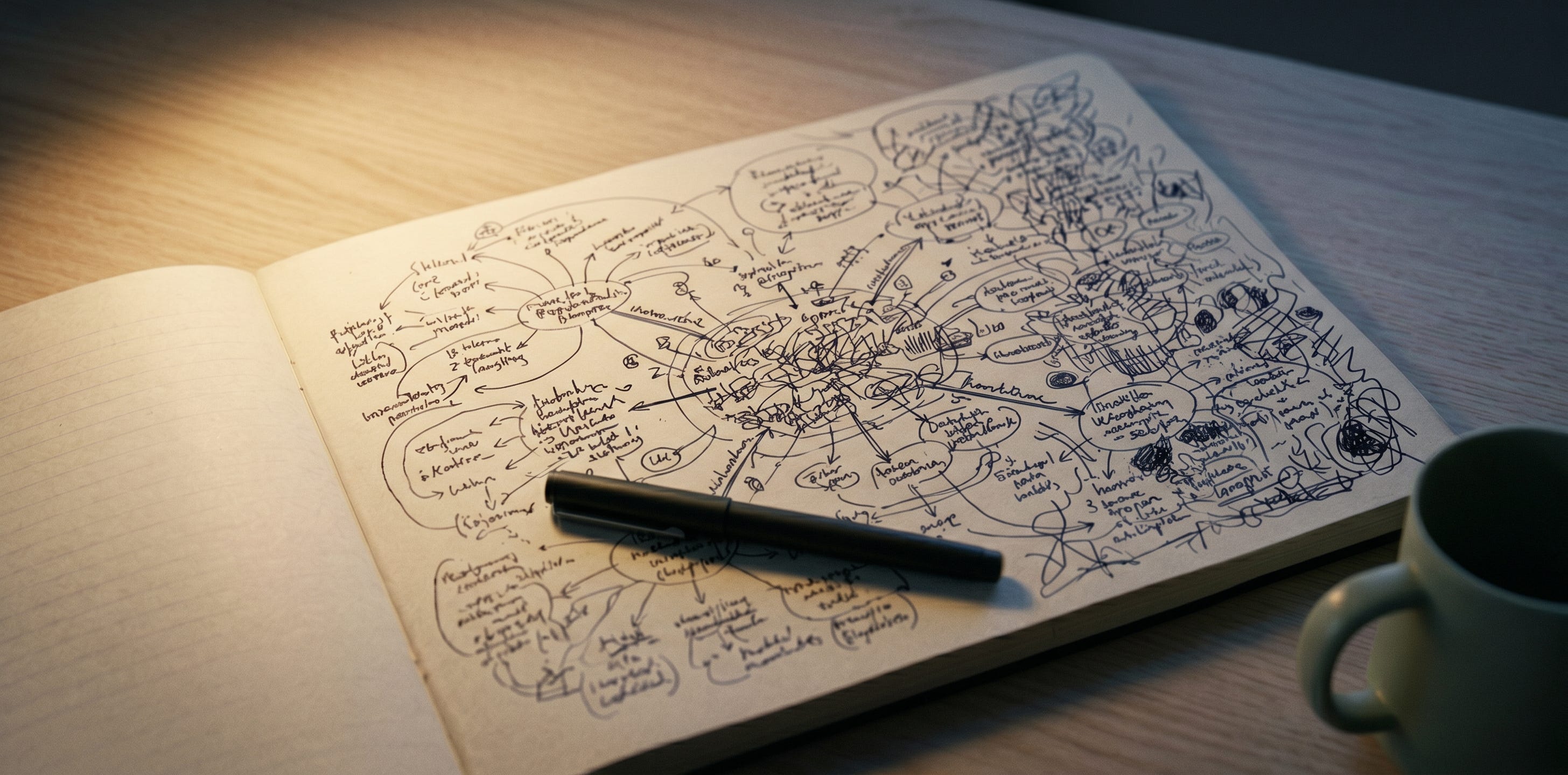
For most of my life I thought my brain ran hot because I was anxious. Generalized Anxiety Disorder, named on a chart at fourteen and restated by various mental health practitioners throughout adolescence and adulthood — the diagnosis I learned to plan around, medicate around, build a career on top of. Anxiety was the explanation for the looping, for the insomnia, for the way a conversation I had at noon would still be re-running in my head at 9 PM alongside two unanswered emails, three half-formed ideas, and an observation about something I heard on a podcast back in February. There was never any reason for me to wonder if that’s all it was.
I was 35 when I got diagnosed with ADHD, and my first response was to push back on it. ADHD in the cultural imagination I’d grown up inside was a boy who couldn’t sit still, while I’d built an entire career on focus. But ADHD in women very often doesn’t look like the cultural cartoon of it; by the time you’re old enough to be assessed, you’ve spent twenty years building a toolkit of coping mechanisms that function as a mask. You over-prepare. You over-research. You externalize your working memory into Notes and lists and screenshots and texts to yourself at 2 AM. You become, in fact, exhausting to be around (first to yourself, and later, when the cost shows up somewhere visible, to anyone else). The toolkit hides the underlying neurology because the masking it enables works.
What the toolkit was hiding, in my case, was a brain that the wellness industry version of the discourse would call my “superpowers” — pattern recognition, hyperfocus, associative leaping. I have a love/hate relationship with that word. I agree with it, but it also lets too much off the hook, and it papers over the cost of running this way for a lifetime. But the cluster is real. An ADHD brain runs on a different relationship with dopamine: it chases the next interesting thing, gets bored fast, and hyperfocuses when the chase pays off. A line a friend says at dinner is also a brand insight is also a memory from 2014 is also a topic to research is also a thing to write about. The connecting happens before I can decide whether I want it to, and on its best days it’s the reason I’m good at what I do for a living.
The same neural setup that wears me out in a loud, crowded restaurant is what lets me see, in three weeks of cultural noise, the pattern a client is paying me to find.
There is now a growing conversation about AI and ADHD (some on Substack, some on Reddit, and increasingly in academic literature) and once you notice the metaphor that conversation runs on, you can’t unnotice it. AI is a crutch (the word recently defended, and meant approvingly, by a thoughtful writer who uses AI to compensate for autism and ADHD). AI is a prosthetic prefrontal cortex. AI is a scaffold. A ramp. A life raft. The Australian HCI conference’s 2025 paper on ADHD adults and ChatGPT is literally titled A Little Bit of a Life Raft. Every one of these metaphors basically assumes ADHD is a deficit and AI’s job is to compensate for it.
I have nothing against compensation. I use AI for compensation things all the time. Reminders, “scaffolds” for tasks I’d otherwise abandon at the 70% mark, the gentle nudge to drink water before I sit down to write. This spring it reconciled my federal and state taxes for me, pulling 1099s from my inbox, cross-referencing receipts and deductions across my own files, flagging things I’d forgotten about, work that would otherwise have been a weekend of dread, or another billable hour from an accountant. The work it does there is real, and life improving. But what about AI’s role for the “superpowers” for neurodivergents?
Even the writers who have done the harder half of the work, like reframing ADHD itself as a different cognitive architecture rather than a deficit, tend to stop short when AI enters the frame. Carlos Perez argues that ADHD isn’t broken cognition; it’s a distinct cognitive architecture with its own strengths. I agree with him most of the way. But when he describes what AI actually does inside that architecture, the language quietly reverts: he calls AI tools “cognitive prosthetics” (his words) designed to “handle routine mental tasks.” The reframing only travels halfway, to the brain but not across to the technology.
What I’d argue instead is that you can carry the reframing across. There’s a whole half of what AI does that the discourse isn’t describing, which is the half on the other side of the diagnostic line: for the strengths. I can think out loud at full speed, with all four channels running, and what comes back can be the thing I was reaching for, plus three things I didn’t know I was reaching for, plus a question that opens the next door.
That last move is the one my brain does on its own, and the one the architecture amplifies. Chudi Nnorukam has gestured at this, describing ADHD pattern-recognition as natively suited to AI architecture work. The closest description for what’s happening on that side is amplification: AI multiplying what the ADHD brain already does on its best days. The compensation frame, on its own, treats the deficit as the real story and the rest of the ADHD brain as collateral. What makes the architecture truly powerful, in my own experience, is the both-ness.
Artificial Intelligence is the first technology I have ever encountered that can keep up with my brain on a good day.
In practice, that looks like something I’ve been building since I started using AI regularly starting with ChatGPT in January 2023 — first as a tool, then as a mirror, then as a system, then as the architecture I’m describing now.
I kept an Apple Note for years called Unexpected Insights (also the name of this Substack). Earlier this spring I ran the whole thing through Claude, and the conversation that came back surfaced a through-line I hadn’t seen across years of seemingly disconnected entries: that they were all, in their own way, about the distance between what is felt and what is understood. That conversation became Full Screen. What made it possible was the architecture I’d been building underneath.
I have had something like 5,000 conversations with AI now since 2023, close to 700 million tokens of stored exchange across Claude, ChatGPT, and Gemini — somewhere between 2,000 and 20,000 gallons of water depending on how you count, or about 6,000 gallons (a small backyard pool) as the central estimate. Three years of writing-with-AI accounts for only about 50 of those gallons; nearly all the rest is the last four months of coding-with-Claude on the apparatus I’m about to describe. That cost is real. While the bulk of AI’s water cost is at corporate-deployment scale — including from corporations laying off workers to invest in AI, my number is part of that picture, if only a small part.
Inside the apparatus, I have a system of memory files (auto-loaded into every new conversation) that holds my preferences, what I’ve decided about a thing, what I’ve revised about a thing, what’s currently unresolved, what I’m not yet sure of. I have feedback files that capture corrections I’ve given the model, so that lessons learned in March don’t have to be re-learned in June. I have files for every active project, including the research I did for this post, so that opening a fresh conversation about it doesn’t mean re-explaining the brief. The whole apparatus lives locally, on my machine, in a directory I can read with a text editor when I want to know what the model knows about me.
I am not a coder. I’ve never learned computer code, unless you count some HTML back in my MySpace and Geocities days. The first time I needed Terminal for this build, my opening message to Claude was “ok so how do I start from the beginning in terminal.” Then “how do I exit and close out of the current session.” Then “ok so it’s in the folder, now what.” I learned the syntax one square at a time, on the way to the next thing I wanted to try, and the model was patient enough to teach me what I needed to know on the way there. It was all a sequence of small curiosities that pulled the next move out of me.
The complexity was the dopamine. The lateral leap (I wonder if I could do X with the thing I already have for Y) is the move my brain has been making in every domain throughout my life, and in this domain the move actually compounds, because every piece I built made the next piece possible. The common refrain on running AI on your own machine — through tools like Claude Code and Claude Cowork (or ChatGPT Codex if you’re in the OpenAI stack), with the model’s memory living in files you can read and edit yourself — is that systems like this are inaccessible because they require technical skill. They don’t. They require a disposition: tolerance for ambiguity, willingness to learn iteratively, and — the part the rest hangs on, for me — finding the discovery itself rewarding enough to keep going. If you have the disposition, the skill arrives by accident, in the doing itself.
But the door also requires time. I built most of this on nights and weekends for years, on top of a full-time job. Plenty of people with the disposition don’t even have that margin. The skill doesn’t arrive by accident for them either. This is, I think, why so many of the strongest accounts of using AI this way come from people who already had the cognitive profile (ADHD, autistic, both) that makes deep iterative discovery feel like rest. Ed Leeman describes the same instinct, externalizing his working memory into status-board and parking-lot files so that, in his words, “I never have to remember where I was. It’s all written down.”
The hyperfocus the discourse calls a symptom is the hyperfocus that built this.
What lives inside the apparatus has two halves, and the compensation and amplification descriptions map on to them respectively. On one side, the things that help with what gets called the deficits. There is a catchup script I run most days that pulls everything new across my personal inbox, my voice-note transcripts, my Apple Notes, my Claude.ai conversation exports, my personal calendar, and any documents I’ve updated since the last run, and tells me what’s overdue, what came in while I was asleep, what I said to myself on tape on Tuesday and forgot about. There is a cross-platform synthesis layer that converges all of those streams into a single readable archive I can search by date, topic, or thread. There are reference files that hold pointers to where every active piece of work actually lives — my brand consultancy proposals in this folder, the Substack draft in that folder, the Claude.ai conversation that has the version of the argument I want to come back to. I do not have to remember any of it. I ask, and the architecture finds it.
The other half is what the same architecture does for the “superpowers.” The cross-platform synthesis layer that surfaces the to-do I lost also surfaces the through-line I didn’t know I was building. The line I voice-noted in March, the Apple Note I made at dinner in April, and the Substack draft I started in May all converge on the same observation. The pattern recognition my brain does instinctively across three weeks of cultural fragments, executed across a corpus far larger than I could hold.
Full Screen was the first time I watched that mechanism work on something this size: years of Apple Notes through one conversation, and a through-line I’d been writing toward without knowing it. The lateral leap finds the cross-domain connection faster because the model can reach across everything I’ve documented when I ask one question — the personal essay note from three weeks ago turns out to be related to an insight I need for a brand proposal I’m working on now. The external processing move (the way I think out loud until the thought clarifies) has a partner I’ve calibrated, over hundreds of corrections captured in memory files, to push back rather than agree. The memory files themselves are the calibration layer: feedback files for process rules, reference files for personal external systems, project files for active consulting work, user files for the standing facts about who I am and how I work. This is what amplification looks like in practice.
This is what people are pointing at when they say AI is becoming a second brain, except the phrase has been overused into a kind of vague positive that mainly evokes Notion templates. To me, it’s more specific: a thinking partner with memory of every prior turn, structured so the model can find the right context when you ask the right question. That structure is the load-bearing piece. Most cloud-chat interfaces can’t provide it; they were built to be sessionless, transactional, identity-neutral, which is why so much AI use, including most of the ADHD discourse, runs in compensation mode by default. It’s also why I’ve moved to Claude Code as what I mostly use AI for now, over Claude.ai. The mode is the architecture. The cross-session piece is what lets the work compound. What I’ve built is a second instance of how my brain works: longer attention span, different storage substrate, running in parallel to the original.
Thom Hartmann recently argued that AI eats linear, predictable work and leaves the divergent, hunter-territory cognition behind — the cognitive style ADHD brains were always shaped for. He’s right about the macro shape, and underselling the part I keep wanting to write into the record: the same AI eating the linear work also amplifies the divergent work, when it is shaped to.
There’s a risk that comes with it. The architecture I’ve built carries my interior, and the same structure that makes it useful makes it portable as no journal ever was. I think it means I owe myself, and anyone else who wants to use AI like this, more vigilance than I’ve had so far. I haven’t yet figured out what that vigilance looks like in practice. The first thing I’m doing is naming it here, in (digital) print, so I can’t quietly forget I owe it.
The same brain that needs the compensation gets the amplification. Both halves are real, and the both-ness is the point.
AI feels like the first instrument that doesn’t ask us to play smaller to be heard.
I’ve been thinking a lot about how to teach this to and build it for others, and I’m going to start with a small, focused workshop later this summer (date TBC).
AI as a crutch will hold for the people it holds for. I’m building for the people who want to use AI as a second, expansive brain — and the architecture that makes that actually work.
P.S. — If you want to help shape it, take this short survey. (You’ll also get the option of having first dibs when I officially announce it.)