

Into a Microphone
On the math of saying it out loud

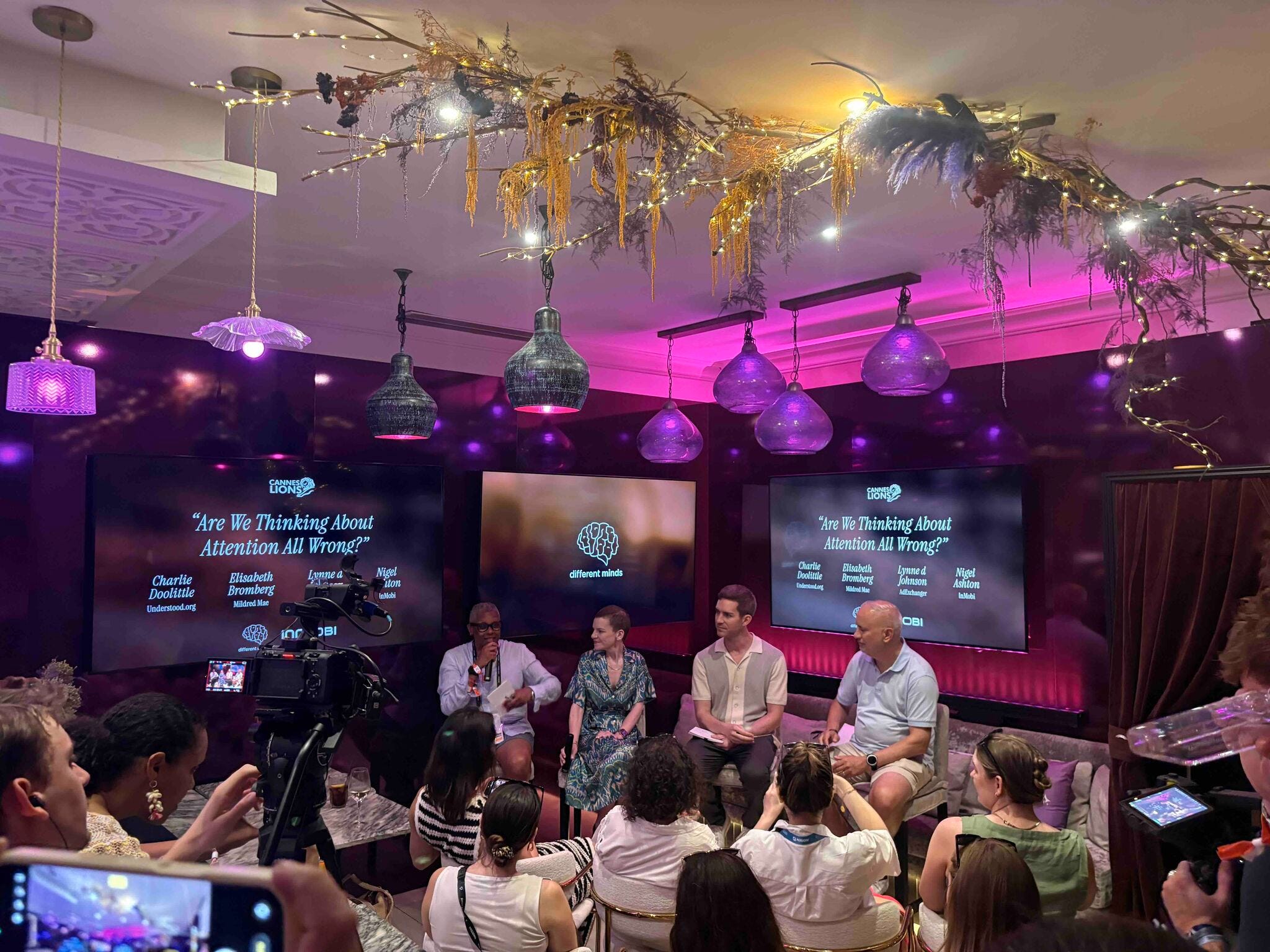
The room was purple. Not tastefully purple — purple like the inside of a jewelry box, pendant lamps and dried branches strung with fairy lights, three screens glowing behind us with a question on them: “Are We Thinking About Attention All Wrong?” And under the question, four names. One of them was mine.
Lynne asked us to introduce ourselves, and I heard myself say it: “I’m Elisabeth Bromberg, I run a brand and social strategy practice named Mildred Mae, after my grandmothers’ middle names, and I have ADHD.”
It took four seconds. It took five years. Both of those are true and I’m still not sure which one the room heard.
I said it twice at Cannes, actually — two days before, on a yacht in the old port, for a Different Minds panel about what AI assumes about brains like mine. Two stages in two days at the advertising industry’s biggest festival, saying the thing out loud, into a microphone, on camera, with my name and my company on a screen behind me. And the whole time, some background process in my head was quietly doing what it has always done: calculating what this was going to cost.
The ticket
I should say up front how I got there, because it’s part of the story.
This was my first Cannes. Seventeen years in this industry, and I had never once been — Cannes is a thing that happens to budgets, and I was never the line item. This year I decided I would be. I bought my own pass. I booked my own flights, my own apartment, months out, on my own dime.
And then, weeks before the festival, I unexpectedly lost my job.
There is a version of what happened next that’s just the sunk-cost fallacy wearing a nice dress: the money was spent, so I went. I’ve turned it over enough times to be honest that the sunk cost was doing some of the work. But it wasn’t the load-bearing part. The load-bearing part was that the reasons I bought the ticket hadn’t changed — if anything they’d gotten sharper. I know the criticism of Cannes, and this year especially I felt it before anyone said it: an industry that has spent all year shedding people, me included, spending eye-watering sums on yachts and rosé to celebrate its own creativity. That criticism is largely right. And I still went, with my own money, because I’ve learned the hard way that the rooms where the industry decides what it is don’t pause for the people it let go. If I wanted to be in the conversation — not the one on the main stages, the one in the small rooms — I had to put myself there.
What I could not have known when I booked it was which small rooms would matter.
The math
Here is the thing I’ve never fully written down: for most of my career, the word didn’t enter rooms where money was present. I got diagnosed at thirty-five, I did the research (it’s literally what I do for a living), I told my friends, I told my family, I eventually wrote about it in public. And still, in professional rooms — interviews, pitches, reviews, anywhere a decision about my value was being made — some quiet spreadsheet ran the numbers and the numbers said wait. Not never. Just: not this room, not yet, not while they’re deciding.
I thought this calculation was mine — my private, slightly shameful arithmetic. Then Charlie Doolittle from Understood.org sat next to me on that purple stage and read the numbers out loud: 70% of neurodivergent employees worry that disclosing will hurt them at work. 72% feel pressure to mask. Nigel Ashton from InMobi had a worse one from that morning’s research: in the creative industry — this industry, the one that gives itself awards for empathy every June — only 18% of neurodivergent people have ever asked for an accommodation.
Which means the calculation was never my private dysfunction. It’s standard operating procedure. Most of us are running it, and most of us think we’re the only ones.
I’ve written before about what all that masking actually costs — the translation tax, the constant conversion of how I see into something legible. What those essays walked around is this part: the years where the diagnosis was real, the understanding was real, the self-acceptance was genuinely underway, and the word still waited outside certain doors.
The room
So what changed?
Honestly — and I want to be precise here, because the inspirational version of this paragraph is a lie — I don’t think I got braver. I think somebody built a different room.
Different Minds didn’t exist a year ago. It’s basically two people, Dayna Moon and Steven Beckwith, who decided the industry needed a community for this and willed it into being: four panels across Cannes week, senior people from InMobi and Understood.org and AdExchanger and agencies and consultancies, sitting on stages saying the quiet parts at normal volume. When Lynne asked the café crowd who identified as “neurospicy,” hands went up. Actual hands, at Cannes, attached to people whose clients and colleagues could see them. And near the end, when she asked whether anyone in the audience wanted to share their own experience — no pressure, no call-outs — two people took the microphone and disclosed. One of them said she’d tried disclosing at work before and it had gone badly, and that she’d decided to be honest anyway, tabs-open brain and all, and let it be endearing rather than apologized for.
I watched that happen from four feet away, and what I felt wasn’t pride, exactly. It was closer to arithmetic. Her math had just come out differently than mine used to. Not because she is braver than I was (although she probably is — I have no way to know), but because the room’s variables were different. Someone had already said it. Several someones, with senior titles, on a stage, under their real names. Every disclosure quietly rewrites the spreadsheet for the person watching.
That’s the thing I actually want to say about Cannes, underneath the panels and the photos and the rosé: stigma doesn’t get argued away. It gets outnumbered.
The homepage
A few weeks ago I rebuilt my website. Mildred Mae is mine now in a way nothing on my CV ever was — my grandmothers’ middle names, my practice, my rules — and when I wrote the copy for my new homepage, I made a decision I would have called professionally reckless at any other point in my career. The first sentence that describes me calls me a neurodivergent senior brand, creative, and social marketer. Not in a bio buried three clicks deep. On the homepage, where the spreadsheet-runners look first.
Farther down the page there’s a line: different minds make different work. I’d love to tell you it’s a wild coincidence that my homepage and a community called Different Minds landed on nearly the same sentence. It isn’t. I wrote it in the weeks before Cannes, already connected to Dayna and Steve, already knowing I’d be on their first panel — the sentence and the stage came out of the same season of my life. Which is the truer and, I think, better story: a lot of us are arriving at the same sentence at the same time.
Here’s what putting it on the homepage actually does, mechanically: it takes the decision away from me. The old calculation ran per-room — this client, this moment, disclose or wait. Now the word is just there, working, at 3am, in rooms I’ll never see, read by people deciding whether to trust me with their brand before I know they exist. Some of them will close the tab. The math has always known about those people.
What the math never had a column for, until this year, was the other ones — the founder who reads the sentence where I describe myself as neurodivergent and exhales, the strategist with the million tabs open who thinks oh, it’s allowed.
The part that doesn’t resolve
I would love to end there. It has the shape of an ending.
But the calculation doesn’t retire just because the word is public now. I ran it again writing this essay — a slower, quieter version: who reads this, which prospective client, what does it cost at the exact moment someone is deciding. I am running it right now, in this sentence. Five years past diagnosis, two microphones later, with it printed on my own homepage, the background process still spins up on its own. Nobody handed it a termination date.
What I have instead of an ending is a ledger with a new column. On one side, everything the math has always known: the recruiter who goes quiet, the client who hears “liability,” the 70%, the 72%, the 18%. On the other side, newer entries, still wet: a purple room where hands went up. A yacht where the question wasn’t whether brains like mine belong in this industry but what the industry keeps missing without us. Two strangers reaching for a microphone because four of us got there first. An email from Dayna afterward saying the conversations shouldn’t end in Cannes — and meaning it, because she’s already building what comes next.
I paid my own way into the most expensive week in advertising, weeks after this industry showed me — not for the first time — exactly how conditional its seats are. And the thing I brought home wasn’t a Lion or a client or a job lead. It was a week where the math kept coming out the other way, out loud, on camera, twice.
I keep the receipts.